Safe wallet review: a strong foundation, with an operating model to design
A documentation-based Safe review covering multisig control, modules, team operations, reporting, and the questions to answer before adopting it.
· 7 min read
On this page
The verdict
Safe is the best open, vendor-independent smart account you can put a treasury in on EVM networks. The contracts are open source, audited across many versions, deployed on hundreds of chains, and governed by a threshold of owners that anyone can verify by reading the chain. If you want an account that keeps working when every company involved disappears, Safe is the reference design.
As a treasury operating system, Safe is a kit rather than a finished product. The core contract enforces one rule, the threshold. Everything else is layered on: spending limits through the Allowance module, transaction previews and risk insights through Safe Shield, an optional managed transaction guard from Hypernative that can block risky transactions onchain, Workspace roles in Safe Wallet, and a paid organizational tier, Safe Pro, launching in October 2026. Each layer is real and useful. Each is also a separate decision with its own trust model, and the CSV export still misses zero-value activity. The interface you sign through is a trust dependency, as the 2025 Bybit incident showed.
| Strengths | Open-source and audited contracts, hundreds of networks, verifiable threshold, flexible owner types, modules for allowances and recovery, Safe Shield previews and an optional onchain guard, self-hostable services, no vendor lock-in |
| Limitations | The core account enforces only the threshold, richer controls are optional extensions and managed integrations you must enable and understand, module and guard risk, CSV export omits zero-value activity, interface trust dependency, gas and per-chain deployments, organizational tier still arriving |
| Best for | DAOs, protocol teams, and engineering-led treasuries that want to own their account and are willing to assemble the controls around it |
| Look elsewhere if | Finance leads want allowlists, tiers, approvals, and reporting delivered as one managed product, or you need non-EVM chains |
Den publishes this blog and builds a policy-enforcing smart account. Our own Guardian and admin authority run on Safe multisigs, which we mention because it should make our respect for the contracts clear and our bias visible.
What you are actually reviewing
"Safe" is several things, and a review has to say which.
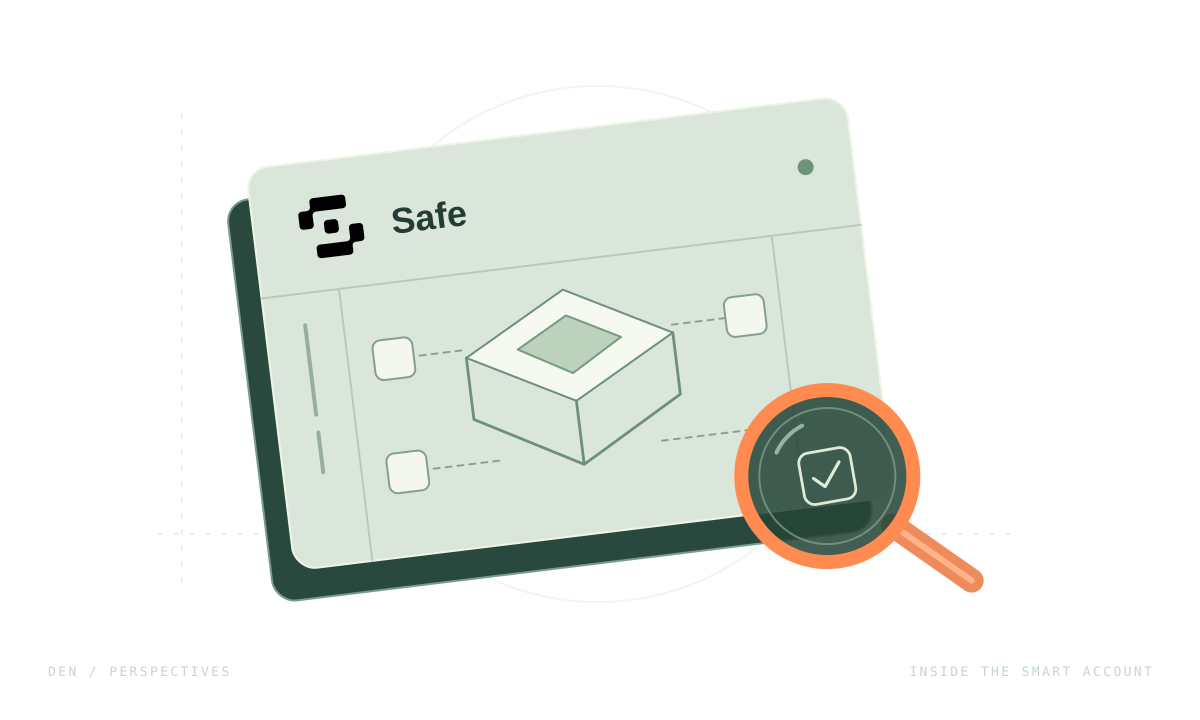
- Safe Smart Account is the contract system: a proxy per account delegating to an audited singleton, with owners, a threshold, modules, guards, and fallback handlers, per the architecture overview.
- Safe Wallet is the hosted web and mobile interface most teams use to propose, sign, and execute transactions, with a teams offering that describes owner, admin, and contributor roles, proposers, spending limits, an address book, simulation flags, and CSV export.
- Safe Shield is the security layer inside Safe Wallet. Its product page describes human-readable transaction previews, risk detection, and customizable auto-block or approve logic, available on desktop and mobile. Copilot runs pre-transaction checks using providers such as Blockaid and Tenderly, flags first-time interactions, and runs pre-execution simulation when available. Guardian by Hypernative is an optional transaction guard, activated on request, that approves low-risk transactions, flags suspicious ones, and blocks high-risk ones before execution, with removal protected by a 24-hour timelock.
- The Transaction Service is the backend that collects off-chain signatures and indexes history. Safe hosts it and you can run your own.
- Safe Core SDK is the developer toolkit for building on the account.
- Modules from Safe and third parties, such as the Allowance module behind spending limits and the recovery module behind RecoveryHub.
- Safe Pro, the paid organizational tier announced in an August 2026 partner program, launching October 6, 2026, with pricing to be published at launch.
Your security review must cover the specific combination you will run. A plain Safe with three hardware-wallet owners, a Safe with the Hypernative guard enabled, and a Safe with two custom modules and a bot delegate are three different systems.
Strengths
Open, audited, and everywhere. The audits page lists reports for every major version and a bug bounty. The supported networks list runs to hundreds of chains and testnets. No vendor decides whether your account exists.
A rule anyone can verify. Owners and threshold are public state. An auditor, a counterparty, or your own board can confirm who controls the money without asking anyone. That is a property no vendor-enclave policy engine can match.
Flexible owners. Owners can be externally owned accounts, other contracts, or passkeys. In practice that means hardware wallets, MPC-held keys from a custody vendor, another Safe, or a phone can all sign the same account.
Extensibility. Modules can add daily spending allowances, recurring payments, and social recovery. A transaction guard can check owner-signed transactions before and after execution, and a module guard can check module-initiated transactions where supported. The Allowance module gives any address, owner or not, a one-time or periodic budget that it can spend without collecting signatures. Safe's own agent quickstart uses it to give an automated signer a daily limit.
Transaction insight and an optional onchain guard. Safe Shield brings previews, risk analysis, and first-time-interaction flags into the signing flow, and the Hypernative guard adds enforcement at the contract boundary with policies for transfer limits, approved counterparties, unverified contract interactions, and multi-signer requirements. This closes much of the gap between "a threshold" and "a policy" for teams willing to enable a managed integration.
Recovery options. Safe RecoveryHub enables a recovery module through which a designated recoverer, from a backup device to an institution, can start a recovery that the owners can cancel during a review window that defaults to 28 days.
Visibility tooling. The Security Hub runs 12 automated checks on an account's configuration and queue and returns a score with plain-language recommendations. It reads your account and changes nothing, which is the right posture for a monitoring tool.
Limitations
The core account enforces approval, not policy. Safe's July 2026 Dappcon talk is literally titled beyond multisig: why approval isn't enough anymore. Its argument is that a threshold tells you how many people agreed, not whether the transaction should have happened, and it lists policies, timelocks, and spend limits as work to bring deeper into the product. The core contract alone cannot say "AP may pay allowlisted vendors up to this amount and nothing else." You get there by enabling the Allowance module, the Hypernative guard, Workspace policies, or your own guard, and each choice adds a component with its own trust and maintenance.
Module and guard risk. The extension points that give Safe its flexibility are sharp. Safe's own documentation warns that a malicious module can take over a Safe because modules execute without owner confirmations, and that a broken guard can cause a denial of service because a guard can block every transaction. That warning applies to a managed guard too: Safe's Hypernative guard carries a 24-hour removal timelock precisely because a guard holds that power. Every module and guard you enable is code your team is responsible for understanding and for being able to remove.
Reporting gaps. The Safe Wallet CSV export includes only transactions with an amount greater than zero. Owner changes, token approvals, and other calls that move no value do not appear. A finance team needs an indexer, the Transaction Service API, or a block explorer to complete the record.
The interface is a trust dependency. The Safe Ecosystem Foundation's statement on the Bybit attack reports that a compromised Safe Wallet developer machine led to the proposal of a disguised malicious transaction, and that no vulnerability was found in the contracts or in the source code of the frontend and services. The contracts did what signers told them to. The lesson is not that Safe is unsafe. It is that a threshold cannot protect signers from approving something they did not understand, and that the device and interface used to review a transaction are part of the security boundary. Safe Shield's previews and risk checks are a direct response to that lesson, and Copilot's documentation notes that it depends on third-party data and shows a notice when a provider is down.
Operating cost and per-chain accounts. Each network needs its own deployment, and each execution pays contract overhead on top of the underlying call. Someone in your team owns gas balances on every chain you use.
An organizational layer that is still arriving. Roles, org-wide administration, audit history across accounts, and professional support are the promise of Safe Pro. Its pricing was not published at the time of writing. The August 2026 delisting of 84 apps from the Safe Wallet app store, based on 180 days of usage data and leaving contracts and users untouched, is a reminder that the surrounding ecosystem is still being curated.
EVM only. Safe does not hold Bitcoin, Solana, or other non-EVM assets.
Who should use Safe
Safe is the right choice for DAOs and protocol teams whose governance already lives onchain, for engineering-led companies that want to own their account and are prepared to choose, audit, and maintain the extensions around it, and for holding high-value assets behind hardware-wallet owners where the operating tempo is low and the threshold is the control you want. With Safe Shield and the Hypernative guard enabled, it is also a credible choice for teams that want previews and onchain blocking without leaving the Safe ecosystem, provided they are comfortable with a managed integration on the critical path. It is also a strong foundation to build on: several wallet products, including Den's Guardian and admin components, use Safe multisigs internally.
Who should look elsewhere or combine
Finance-led teams that want allowlists, tiers, rate limits, approval routing, and reporting delivered as one product, rather than assembled from a module, a managed guard, Workspace roles, and an indexer, should look at platforms with an integrated policy engine, whether vendor-enclave MPC platforms or a policy-enforcing smart account. Teams with non-EVM assets need an MPC platform for those chains. And many treasuries do well with a combination: a Safe for long-term reserves and a policy-based account for operations.
How Den relates
Den's accounts are smart contracts too, and Den builds the policy layer into the account rather than adding it as an extension: a policy engine with auto-approval and M-of-N rules, recipient allowlists, amount and time limits, and contract-call restrictions by function and argument, enforced onchain and independently re-checked by the signing client and by Den's Guardian service. Governance changes need a configurable admin threshold. The contracts are open source and audited, and Den's own Guardian and Admin authorities are Safe multisigs, as the contracts repository documents.
The tradeoffs run the other way. Den is a managed service with a Guardian in the standard flow, supports a shorter list of EVM networks, and is not something you can deploy from a repository this afternoon. Safe's independence is real and Den does not claim to replace it. If you like what a Safe verifies but want the policy, approvals, and reporting as one product with onchain enforcement, that is the gap Den is built for.
Read Safe vs MPC wallets for the architecture behind this review, or how to plan a migration from Safe to a policy-based wallet if you have decided to move part of your operation.